
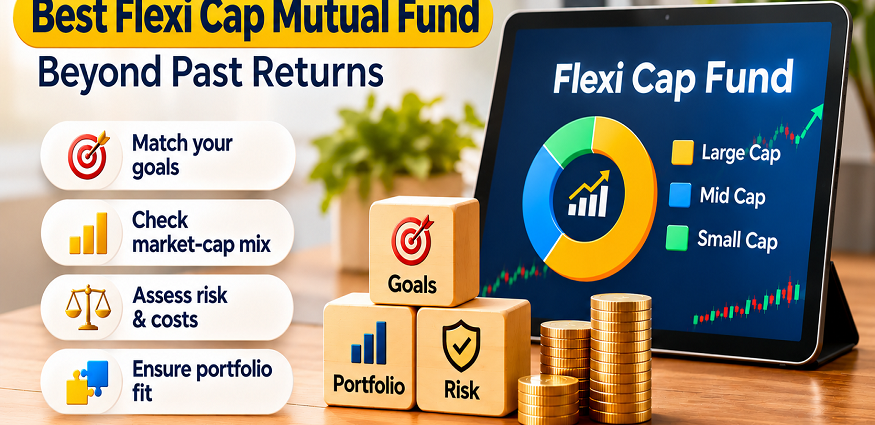
The best flexi cap mutual fund for you will depend on the market-cap allocation, the investment philosophy and the risk characteristics of the fund and how it will fit into your existing portfolio. Don’t just go by historical returns. Flexi cap funds allow fund managers the freedom to invest across large, mid and small cap companies but the portfolio composition and investment strategy can vary widely. For someone who already holds large-cap funds, a fund aimed at a first-time investor could cause unwanted overlap in the portfolio. And a more aggressive investor with a large mid- and small-cap exposure may require a different allocation approach. So, investors should evaluate a fund in the light of their financial objectives, investment horizon and risk appetite to make informed long-term investment decisions.
1. Understanding How a Flexi Cap Mutual Fund Works
A flexi cap fund is an open-ended equity mutual fund which invests across companies of different market capitalizations. According to the mutual fund classification framework of SEBI, these funds are required to invest a minimum of 65% of total assets in equity and equity related instruments. Multi cap funds have minimum mandatory allocation requirements for individual market-cap segments and Flexi cap funds do not. Fund managers can change their exposure to large, mid and small companies based on valuations, business fundamentals, market conditions and investment opportunities. This flexibility gives fund managers the possibility to pursue varying investment strategies. But, it also means that investors cannot assume that all flexi cap mutual funds have similar diversification or risk characteristics. Some schemes may continue to maintain predominantly large-cap portfolios while others may take meaningful exposure to emerging mid and small cap businesses.
2. Why Past Returns Alone Cannot Identify the Best Flexi Cap Fund
Past returns and fund ratings can help investors choose schemes, but they offer little insight into future suitability. For instance, a flexi cap fund with heavy small-cap exposure may beat its peers during a strong small-cap rally. But the same allocation could lead to increased volatility during a market correction. Similarly, a fund loaded with large-cap stocks could underperform more aggressive rivals for a time, without straying from its investment philosophy.
Rather than depending solely on past rankings, investors should look at:
- Three and five year rolling returns.
- Performance relative to the stated benchmark.
- Risk-adjusted returns for the same period.
- Historical drawdown and recovery times.
- Consistency of the fund’s investment approach.
These indicators give a more complete picture of how a fund has delivered returns and managed risk historically.
3. Evaluate Market-Cap Allocation and Investment Philosophy
While choosing a flexi cap mutual fund, the underlying portfolio is one of the most important things. Large-cap companies generally have established business models, whereas mid- and small-cap companies may offer growth opportunities, but also higher business, liquidity and valuation risks.
But market-cap allocation alone doesn’t tell us about a fund’s investment characteristics. Fund managers may also have different investment philosophies.
- Growth investing: Looking at companies with a strong potential for growth in earnings.
- Value investing: Selecting businesses that are trading below their intrinsic value.
- Quality investing: Focussing on financial strength, profitability and sound business models.
- Blended investing: Mixing different approaches based on what’s available.
Investors should look at past portfolio disclosures to see if changes in portfolio allocations are a result of a disciplined investment process or frequent changes based on short term market trends. A fund’s investment philosophy should match the investor’s expectations and ability to stay invested through periods of underperformance.
4. Does a Top Flexi Cap Fund Complement Your Existing Portfolio?
A highly rated fund may not necessarily improve portfolio diversification. Its suitability depends partly on the investments an individual already holds.Consider a hypothetical flexi cap mutual fund with the following market-cap allocation.
| Market-cap segment | Hypothetical allocation |
| Large-cap companies | 65% |
| Mid-cap companies | 20% |
| Small-cap companies | 15% |
| Total | 100% |
Let’s look at this same fund through the eyes of three different investors.
Investor A: First time mutual fund investor
A diversified holding of equities, useful for an investor starting out on their equity investment journey. Exposure across market cap segments with access to different investment opportunities in a single scheme. However, the investor must have the right investment horizon and risk tolerance to be able to withstand the volatility of the equity market.
Investor B: An investor who already has large-cap funds
If an investor has significant large cap exposure, then adding this flexi cap fund could lead to a lot of duplication. 65% of the portfolio is invested in large-cap companies. The additional investment may not provide a meaningful diversification of the portfolio but rather reinforce existing exposures. Reviewing the overlap of individual stocks and sectors is of particular importance.
Investor C: A high-risk investor with mid and small cap exposure
The fund’s large-cap exposure may be useful to an investor with a large number of mid- and small-cap investments, to balance out existing market-cap exposure. But the new mid- and small-cap holdings might contribute to portfolio volatility. This allows the same fund to be used for different portfolio objectives, based on an investor’s current asset allocation.
5. Illustrative Calculation: How the Same Fund Changes Three Portfolios
Assume that each of the investors puts in ₹2 lakh into the hypothetical flexi cap mutual fund we discussed above. Investors B and C already have an ₹8 lakh in equity mutual funds, and investor A is starting a new equity portfolio.
| Particulars | Investor A | Investor B | Investor C |
| Existing equity investments | ₹0 | ₹8,00,000 | ₹8,00,000 |
| Flexi cap fund investment | ₹2,00,000 | ₹2,00,000 | ₹2,00,000 |
| Total equity portfolio | ₹2,00,000 | ₹10,00,000 | ₹10,00,000 |
| Existing large-cap allocation | — | 80% | 20% |
| Existing mid-cap allocation | — | 15% | 40% |
| Existing small-cap allocation | — | 5% | 40% |
| Revised large-cap allocation | 65% | 77% | 29% |
| Revised mid-cap allocation | 20% | 16% | 36% |
| Revised small-cap allocation | 15% | 7% | 35% |
Illustrative calculation assumes fully invested equity portfolios, unchanged underlying allocations and no market price movements. Figures do not represent actual mutual fund schemes or recommended portfolio allocations.
The calculation indicates that Investor B still has a significant large-cap exposure even after adding a diversified fund. Investor C, by contrast, raises large-cap exposure from 20% to 29%, thereby decreasing the proportional reliance on mid- and small-cap companies. In each case the fund is the same but its effect on each portfolio is quite different.
6. Assess Risk-Adjusted Performance, Expenses and Fund Management
Investors evaluating a flexi cap fund should consider the efficiency with which historical returns were generated.The following metrics can support this assessment:
| Evaluation metric | What it helps investors assess |
| Sharpe ratio | Measures excess return over total volatility |
| Sortino ratio | Measure of excess return to downside volatility |
| Alpha | Risk-adjusted performance relative to a benchmark-based model |
| Maximum drawdown | Largest drop from a high to a low in the past value of a portfolio |
| Expense ratio | Annual scheme operating expenses |
| Portfolio turnover | Frequency of changes in portfolio holdings |
Metrics should be compared over comparable timeframes, plan types and calculation methodologies. Investors should also look at the fund manager’s tenure, investment philosophy and consistency in building the portfolio. Change in fund management or investment approach may cause past performance not to be indicative of future performance. Useful to evaluate independently are official AMC factsheets, scheme documents, AMFI and reputed mutual fund research platforms.
7. A Practical Checklist Before Choosing a Flexi Cap Fund
Before investing, investors should:
- Identify their financial objectives and investment time horizon.
- Assess their ability to bear losses in the equity market.
- Analyse the current market cap and exposure to sectors.
- Review existing investments for portfolio overlaps.
- Compare rolling returns and relative performance against benchmark returns.
- Review expenses, drawdowns and fund manager consistency.
- Look at the scheme’s Riskometer and investment objective.
- Before switching existing investments, check out exit loads and capital gains tax.
A disciplined evaluation process can help investors resist the temptation to switch funds and react to short-term performance rankings.
Conclusion
The best flexi cap mutual fund may not be the one that has delivered the highest historical returns or the best rating. Whether it’s right for you depends on how well its investment strategy aligns with your financial objectives, existing portfolio and risk tolerance. Investors can make better decisions by comparing market-cap allocation, investment philosophy, expenses and risk-adjusted performance. Ultimately, it matters more to have a proper portfolio and with disciplined invest for the long term, than to catch the next best scheme.
Frequently Asked Questions
- How do I pick the best flexi cap mutual fund for my portfolio?
Look at market-cap weighting, portfolio overlap, rolling returns, expense ratio and downside risk in terms of your financial objectives and investment time-frame.
- Is flexi cap fund good for first time investors?
Suitable for investors seeking diversified equity exposure through a single scheme with long term investment horizon and appropriate risk tolerance.
- Can I invest in large cap and flexi cap funds?
Yeah. But investors should look at the underlying stock and sector overlap to see if owning both funds provides any meaningful diversification
- Does a top flexi cap fund always beat its benchmark?
No. Historical rankings are not predictive of future outperformance of benchmarks. Market conditions, investment decisions and portfolio allocation affect the scheme performance.
- How frequently should I monitor my flexi cap mutual fund?
Long-term investors may want to review their portfolios every six to 12 months. Don’t switch funds just because of short term underperformance or changes in fund rankings.
Disclaimer: This article is for educational and informational purposes only and does not constitute investment advice. All portfolio allocations and calculations are hypothetical and should not be interpreted as investment recommendations.
Mutual Fund investments are subject to market risks, read all scheme related documents carefully.